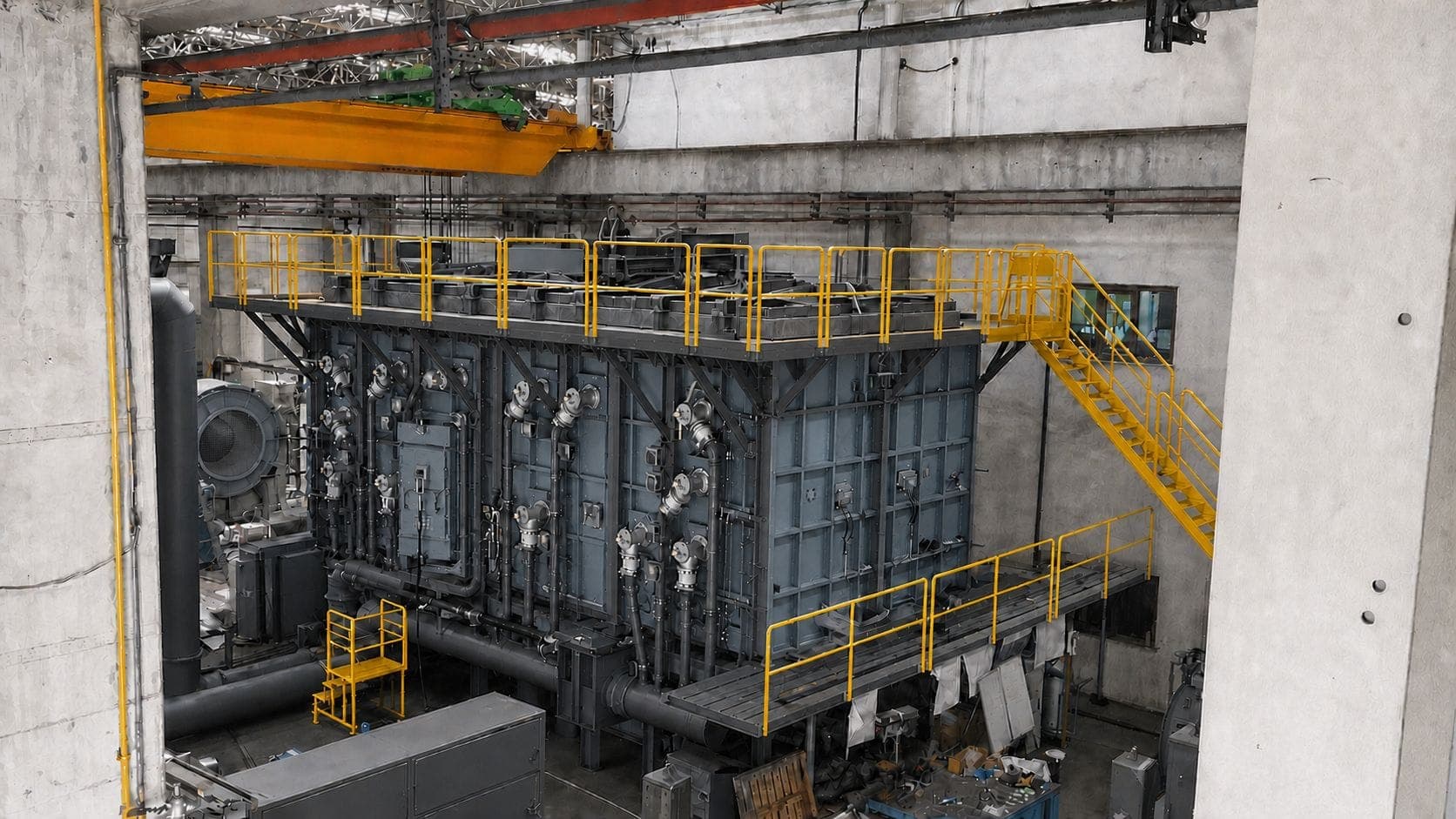
Combi Furnace
Combi Fire Resistance Test Furnace
Horizontal, vertical and corner testing in a single unit, combining multiple test orientations within one laboratory solution.
Flexible Laboratory Capability
Vertical + Horizontal + Corner in One Concept
- Walls and partitions
- Doors and closures
- Façade elements
- Floors and roofs
- Ceilings
- Beams and structural assemblies
- Penetration and joint systems
- Ducts and dampers
- Research and development programmes
Key Characteristics
- Fully capable of performing horizontal, vertical or corner tests; corner capability for façade and junction specimens
- Roof extension option: a 4 × 2 × 4 m extension delivered on a 4 × 4 × 4 m gas-fired combi furnace enables vertical tests of 4 × 6 m
- Corner configurations delivered up to 4 × 4 × 8 m
- Pre-cast, pre-cured refractory blocks: rapid repair without full relining
Final geometry, test opening, specimen-frame concept, combustion arrangement and handling system are engineered around the intended test programme. No generic size is assumed unless specified for the project.
Complete Combi Furnace System
The Combi Furnace is intended for laboratories that want to broaden their fire resistance testing capability while reducing the need for multiple, completely independent furnace installations.
Furnace & Frames
Combined furnace architecture, refractory construction and test-frame systems adapted to vertical and horizontal use.
Combustion & Pressure
Industrial burners, gas and air distribution, automatic fire-curve control and furnace pressure management.
Control & Measurement
PLC/SCADA control, thermocouples, pressure measurement, oxygen monitoring and project-specific instrumentation.
Performance
- Furnace pressure control: ±2 Pa within the specified pressure range
- Fire curves: ISO 834, slow heating, HC, HCM, RABT, RWS and project-specific curves
- Maximum temperature capability: up to 1,350 °C, depending on furnace configuration
- Burner power: configurable according to furnace size and required fire curve
- Control: fully automatic PLC/SCADA operation with manual override
- Fuel options: natural gas or light fuel oil, according to project requirements
Maximum temperature, burner power and curve set are specified per project; 1,350 °C is the capability ceiling of the range, not the rating of every furnace.
Refractory Construction
- High-alumina refractory materials selected according to furnace temperature and duty
- Insulating refractory layers designed to reduce heat losses and external surface temperatures
- Low-thermal-mass construction for controlled thermal response
- Modular refractory design to facilitate inspection, maintenance and replacement
- Engineered expansion joints to accommodate thermal movement and reduce deformation
Steel Structure
- Heavy-duty welded steel structure engineered for repeated thermal cycling
- Structural design adapted to furnace dimensions, specimen loads and laboratory configuration
- Furnace casing and reinforcement designed for dimensional stability during testing
- Accessible construction for inspection and maintenance
- Surface protection and finishing according to project and environmental requirements
Referenced Standards
- EN 1363-1 / -2
- EN 1364 series
- EN 1365 series
- EN 1366 series
- EN 1634-1
- BS 476
- ASTM E119
- UL 10B / 10C
Furnace configuration, instrumentation and control systems are engineered according to the applicable test standards and the laboratory's specific testing programme. Final compliance capability depends on the delivered configuration, instrumentation, commissioning and the exact applicable edition of each standard.
Selected Combi Furnace Projects
- Country
- India
- Laboratory
- Fire testing laboratory, Chennai
- Scope
- Complete laboratoryComplete laboratory: concept, design, production, commissioning and technician training
- Equipment
- Gas-fired Combi furnace 4 × 4 × 4 m with a roof extension (4 × 2 × 4 m) enabling vertical tests over a height of 4 × 6 m
- Country
- Slovenia
- Laboratory
- National building institute
- Scope
- Complete laboratoryComplete laboratory: concept, design, commissioning and technician training
- Equipment
- One light-fuel-oil-fired multi-configuration furnace to EN 1363-1: vertical 4 × 4 m; horizontal 4 × 4, 4 × 8, 4 × 6 and 4 × 2 m; corner tests 4 × 4 × 4 m, 4 × 4 × 6 m and 4 × 4 × 8 m
Other Configurations
Request Information
Discuss Your Project
Contact STARKOS to define your test programme, standards, specimen dimensions, instrumentation and laboratory requirements.